Where are Heriz rugs made?
 Sarah Cherry
.
In respect to this, where are Serapi rugs made?
The region where the Serapi rugs are crafted is in North West Iran. Years ago when the largest number of these hand woven works of art were being crafted, they were made in the same region responsible for Bakshaish rugs and Heriz Rugs: the region of Heriz.
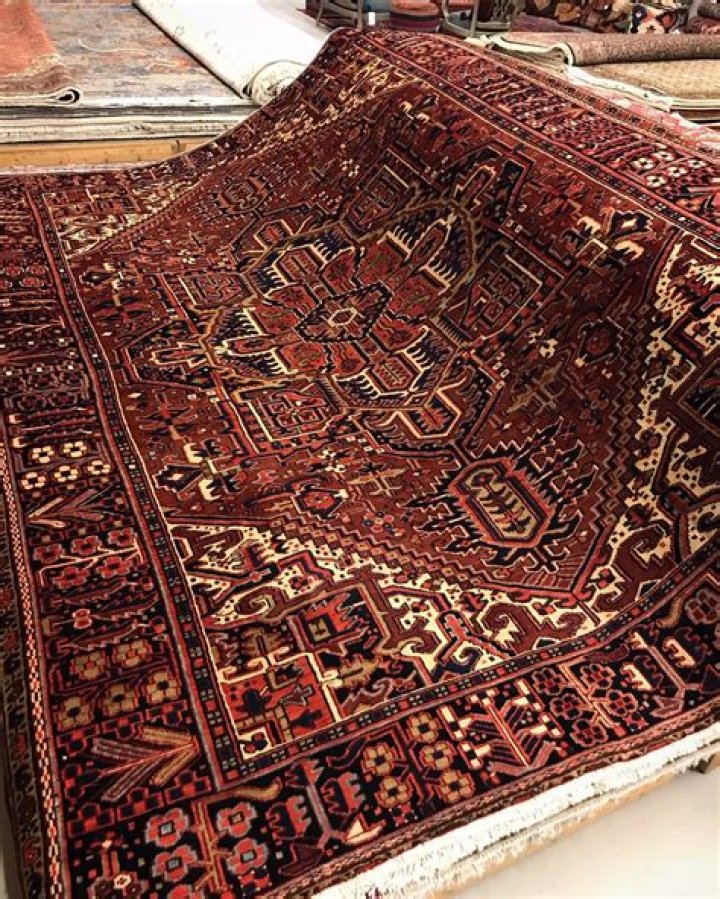
Subsequently, question is, what does Heriz mean? He·riz. (hîr′ēz, -ēs) A durable, finely woven Persian rug typically having a large central, often diamond-shaped medallion design with intricate background decoration. [Alteration of Heris, a town of Iran.]
Similarly, what is Heriz Serapi rug?
Heriz / Serapi. Serapi is a trade name given to better quality Heriz rugs thought to have been woven before 1900. In the United States, the highest quality of Heriz rugs are called Serapi. The name Serapi originates from the village of Serab.
What are the different types of Persian rugs?
Types of Persian rugs include Bakhtiari, Bijar, Eshfahan, Farahan, Gabbeh, Heriz/Serapi, Kashan/Mohtasham, Kerman, Khorassan/Mashad, Persian Kilims, Malayer, Sarouk, Senneh, Sultanabad/Mahal and Tabriz. To read more about the different types of Persian rugs, click here.
Related Question Answers
What is Bokhara rug?
Bokhara is a term commonly used to describe Tekke-faced rugs. Tekke was a tribe from the area of Bokhara in Central Asia. The design is dominated by rows of guls and surrounding geometric patterns.What is a Tabriz Persian rug?
A Tabriz rug/carpet is a type in the general category of Persian carpets from the city of Tabriz, the capital city of East Azarbaijan Province in north west of Iran totally populated by Azerbaijanis. It is one of the oldest rug weaving centers and makes a huge diversity of types of carpets.What is a Kazak rug?
Originally woven with strands of silver and gold, Kazak rugs were, at one point, symbols of status. They were placed in churches, palaces and within homes of the elite class. They were not only used as floor coverings but they often hung from walls and placed on the throne or at the feet of the king.How much does a Persian carpet cost?
With these prices in mind, a 6x9 authentic, hand-knotted oriental rug could cost anywhere between $1,000 and $5,000. Be aware of the rug's size, knot count, origin and materials before purchasing to determine whether it's priced fairly or not.Where do Persian rugs come from?
By the strictest definition, Oriental rugs are carpets hand knotted only in Asia. Iran, China, India, Russia, Turkey, Pakistan, Tibet and Nepal are some of the biggest rug exporters. Persian rugs also are Oriental rugs but they are made only in Iran (formerly known as Persia).How can you tell if a Persian rug is authentic?
Signs to Identify Fake Oriental Rugs- Your Rug has a Hard Plastic Back.
- The Colors are Bleeding.
- The Fringe is Sewn or Glued On.
- It's Not Hand Knotted.
- The Rug Isn't Made With Wool.
- You Got a "Steal" on the Rug.
- Going out of business sales.
Who makes the best rugs in the world?
We'll take a look at the three of them, so you can see each of their strengths.- Iran. Iran is one of the most popular countries to buy rugs from.
- Pakistan. Pakistan uses similar techniques with Iran to develop its rugs.
- India. India, to no one's surprise, produces more rugs than any other country in the world.
What is the difference between Persian and Oriental rugs?
Another difference between Oriental and Persian rugs is the type of knot used to create the rug. True Oriental and Persian rugs are hand knotted on looms. Oriental rugs are tied with symmetrical Ghiordes knots. Persian rugs are most often knotted using an asymmetrical or Senneh knot.What is so special about Persian rugs?
The rugs are not only floor coverings – they're works of art. Renowned for their rich colors and interesting designs, Persian rugs are made with all-natural wools, silk and vegetable dyes, rather than synthetic materials. Their beauty, and the impact it will have on your home, cannot be overstated.How do I know if I have an Oriental rug pattern?
There are a few tips you can look for when trying to identify a handmade Oriental rug.- Look on the back of the rug at the weave.
- Look for unevenness in the colored knots on the back of the rug.
- Now look at the front of the rug.
- You may notice slight color changes making thick or thin stripes in the rug.