Is logic a branch of philosophy?
 Sebastian Wright
 .
People also ask, what are the branches of logic?
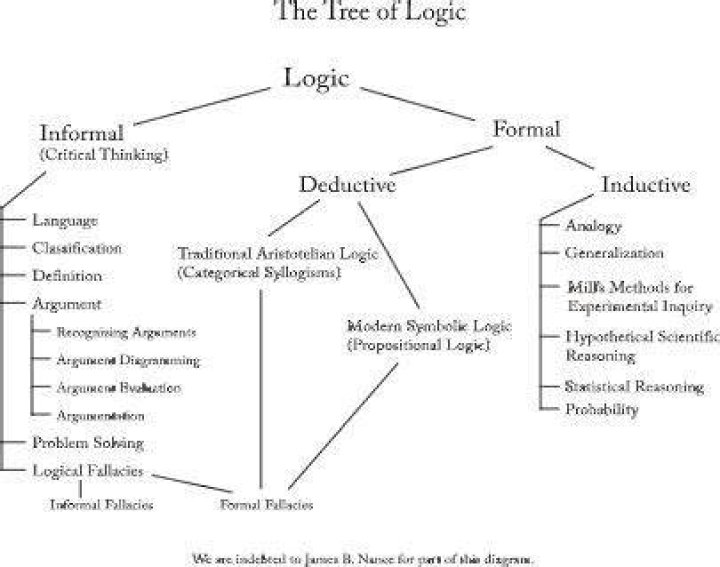
Logic in general can be divided into Formal Logic, Informal Logic and Symbolic Logic and Mathematical Logic:
- Formal Logic:
- Informal Logic:
- Symbolic Logic:
- Mathematical Logic:
Beside above, what are the 4 main branches of philosophy and their meaning? The four main branches of philosophy are logic, epistemology, metaphysics, and axiology: Logic is the attempt to codify the rules of rational thought. Metaphysics is the study of the nature of things. Metaphysicians ask what kinds of things exist, and what they are like.
Similarly, you may ask, what are the types of logic in philosophy?
There are two types of logical arguments - deductive and inductive. Examples of these are: Deductive - This type of reasoning provides complete evidence of the truth of its conclusion. It uses a specific and accurate premise that leads to a specific and accurate conclusion.
Is math a branch of philosophy?
The philosophy of mathematics is the branch of philosophy that studies the assumptions, foundations, and implications of mathematics. The logical and structural nature of mathematics itself makes this study both broad and unique among its philosophical counterparts.
Related Question Answers
Who is the father of logic?
Aristotle
Who is father of philosophy?
Socrates
What is an example of logic?
noun. The definition of logic is a science that studies the principles of correct reasoning. An example of logic is deducing that two truths imply a third truth. An example of logic is the process of coming to the conclusion of who stole a cookie based on who was in the room at the time.What are the basic principles of logic?
Logicis often defined as the systematic study of arguments and correct reasoning.
The three basic laws of logic.
- the law of identity, A=A.
- The law of non-contradiction- A proposition cannot be BOTH True and False.
- The law of excluded middle (LEM)- A proposition MUST be EITHER True or False.
What is simple logic?
Logic is the study of reasoning. The rules of logic let philosophers make true and logical deductions about the world. Logic helps people decide whether something is true or false. Logic is often written in syllogisms, which are one type of logical proof.What is the importance of logic?
Logic is important because it influences every decision we make in our lives. Logical thinking allows us to learn and make decisions that will affect our lifestyle. If no one thought logically, we would all be running around like chickens with our heads cut off, and nothing would make any sense.What are the 4 types of reasoning?
- Reasoning-process of thinking about things in a logical and rational way.
- These are the four types of reasoning.
- Logical reasoning, verbal reasoning,non verbal reasoning,
- Logical reasoning Inductive reasoning Deductive reasoning Abductive reasoning.
- lets discuss on call - 9785777484.
What is logic theory?
In mathematical logic, a theory (also called a formal theory) is a set of sentences in a formal language that is closed under logical implication. In most scenarios, a deductive system is first understood from context, after which an element of a theory is then called a theorem of the theory.What are the characteristics of logic?
Usually, a logic will contain at least: A syntax of propositions, letting us say that, for example, , , or are propositions of various systems. A deduction system, allowing us to show that particular propositions are derivable (possibly from certain hypotheses).What is the importance of logic in philosophy?
The Logic of PhilosophyPhilosophy is based on reasoning, and logic is the study of what makes a sound argument, and also of the kind of mistakes we can make in reasoning. So study logic and you will become a better philosopher and a clearer thinker generally."What is a logical person called?
Logical describes something that comes from clear reasoning. The adjective logical is rooted in the Greek word logos, which means "reason, idea, or word." So calling something logical means it's based on reason and sound ideas — in other words, thought out with mathematical precision and removed from emotion.How is logic used in philosophy?
Philosophical logic is the branch of study that concerns questions about reference, predication, identity, truth, quantification, existence, entailment, modality, and necessity. Philosophical logic is the application of formal logical techniques to philosophical problems.What is pure logic?
Pure Logic. 1902 | Pure | CP 2.544. … Pure Logic, a phrase often used, but to which no distinct conception can be attached. [—] Perhaps we may say that pure logic is a logic deduced from hypotheses (which some will look upon as axioms) without any inquiry into the observational warrant for those hypotheses.What are the tools of philosophy?
Philosophy uses the tools of logic and reason to analyze the ways in which humans experience the world. It teaches critical thinking, close reading, clear writing, and logical analysis; it uses these to understand the language we use to describe the world, and our place within it.What is formal logic used for?
Formal logic as a study is concerned with inference forms rather than with particular instances of them. One of its tasks is to discriminate between valid and invalid inference forms and to explore and systematize the relations that hold among valid ones.How can I have logical thinking?
Steps- Test your recall. Your brain, like any other body part, improves with exercise.
- Do crossword puzzles. The benefit of crossword puzzles on the mind is well documented.
- Learn a new talent. Learning new abilities requires a lot of logical thinking.
- Socialize.
- Change up your routine.
What is philosophical reasoning?
Reason, in philosophy, the faculty or process of drawing logical inferences. The term “reason” is also used in several other, narrower senses. These fundamental truths are the causes or “reasons” of all derivative facts.What are the 7 branches of philosophy?
Terms in this set (7)- Metaphysics. branch of philosophy dealing with the nature of existence.
- Epistemology. the philosophical theory of knowledge.
- Anthropology. the social science that studies the origins and social relationships of human beings.
- Ethics.
- Logic.
- Political Science.
- Aesthetics.
How many branches are there in philosophy?
Six Branches