How do you use enough?
 Emma Powell
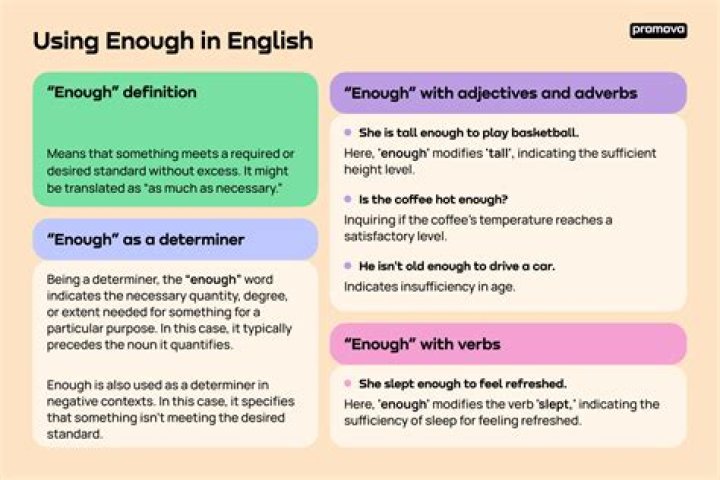
 - ENOUGH with adjectives and adverbs. Position in a sentence: after an adjective or an adverb. Your work isn't good enough for our company.
- ENOUGH with nouns. Position in a sentence: before a noun. There aren't enough tomatoes in the fridge.
- ENOUGH without a noun. We can also use ENOUGH without a noun:
- ENOUGH OF.
.
Hereof, how do you use too or enough?
Meaning
- Too is used to mean more than sufficient or more/less than necessary. It's too late to stop him.
- Enough is used to mean sufficient. Your clothes are big enough to fit me.
- Enough is used in negative sentences to mean less than sufficient or less than necessary.
Secondly, what is enough in English grammar? Grammar > Nouns, pronouns and determiners > Quantifiers > Enough. from English Grammar Today. Enough is a determiner, a pronoun or an adverb. We use enough to mean 'as much as we need or want'.
Also know, what kind of adjective is enough?
Enough as an adjective and adverb. Enough is one of those words that can be used as an adjective and an adverb. The adverb enough is used to modify an adjective. In this case, it goes after the adjective it modifies.
When can I use too?
Too. To is a preposition with several meanings, including “toward” and “until.” Too is an adverb that can mean “excessively” or “also.” Just to be clear: two is pronounced the same as to and too, but it can't be used instead of either of them because it's a number.
Related Question Answers
What is too and enough in English grammar?
Too and enough indicate degree. They modify adjectives, adverbs, and nouns. Too means more than what is needed. Enough means sufficient.How do you teach too?
Structure: Too is usually found at the end of a sentence after a comma (also meaning) or before an adjective or adverb (very meaning).
2. TOO
- I want to go to Paris, too. (also)
- Me, too. (also)
- The teacher spoke too quickly, so the students were confused.
- That desk is too large to move by myself.
Can we use too in negative sentences?
Rule: when the verb is negative, you cannot use “too.” Remember that we are talking about the verb and NOT the meaning of the message. For example, “I hate carrots.” has a negative meaning, but the verb hate is not in a negative form.Is to an adverb?
The word 'to' is thought to be a preposition. However, since a preposition needs an object and a verb cannot be an object, can 'to' be more of an adverb, since it modifies a verb in the structure? An adverb modifies a verb. In: I look forward to meeting you; 'meeting you' is not an object; etc.How can I use any and any in English grammar?
Some- Some is used with both countable and uncountable nouns:
- Some is used in positive sentences:
- Some is also used in questions when we are making a request:
- Any is used in negative sentences:
- Any is used in questions:
Is more an adverb?
1. 2. When "more" is used before adjective or adverb as "inconvenient" in your example, it is an adverb whose primary function is to modify the following word. However, when it is used before a noun (or sometimes after a noun), it is used as a determiner or adjective.Is enough an adjective?
Enough is one of those words that can be used as an adjective and an adverb. The adverb enough is used to modify an adjective. In this case, it goes after the adjective it modifies. She is old enough to earn a living.Is enough a noun or adjective?
enough means 'as much as necessary'. It can be used with an adjective, an adverb, a verb or a noun. It can also act as a pronoun.Is enough an adverb or adjective?
Enough can be used as an adjective and an adverb. As an adjective, enough goes before the noun it modifies. As an adverb, enough goes after the adjective or adverb it modifies.What are adjectives give 10 examples?
Examples of adjectives- They live in a beautiful house.
- Lisa is wearing a sleeveless shirt today. This soup is not edible.
- She wore a beautiful dress.
- He writes meaningless letters.
- This shop is much nicer.
- She wore a beautiful dress.
- Ben is an adorable baby.
- Linda's hair is gorgeous.
What kind of parts of speech is enough?
enough
| part of speech: | adjective |
|---|---|
| part of speech: | adverb |
| definition 1: | in a way or to a degree that satisfies a need or requirement. The job doesn't pay enough. synonyms: adequately, satisfactorily, sufficiently |
| definition 2: | quite; fully. He was ready enough to begin. similar words: fully, quite |
What are the 8 types of adjectives?
The 8 Most Common Types of Adjectives- QUANTITATIVE ADJECTIVES. DEFINITION.
- DEMONSTRATIVE ADJECTIVES. DEFINITION.
- DESCRIPTIVE ADJECTIVES. DEFINITION.
- INTERROGATIVE ADJECTIVES. DEFINITION.
- POSSESSIVE ADJECTIVES. DEFINITION.
- ARTICLES AS ADJECTIVES. DEFINITION.
- DISTRIBUTIVE ADJECTIVES. DEFINITION.
- INDEFINITE ADJECTIVES. DEFINITION.
What is very in grammar?
This word is categorized as an adverb if it is used to modify a verb, an adjective, or another adverb in a particular sentence. For instance, in the sample sentence below: She worked very quickly. The word “very” is considered as an adverb because it modifies another adverb “quickly.”What are the 5 types of adjectives?
Types of Adjectives- Descriptive Adjectives.
- Quantitative Adjectives.
- Proper Adjectives.
- Demonstrative Adjectives.
- Possessive Adjectives.
- Interrogative Adjectives.
- Indefinite Adjectives.
- Articles.