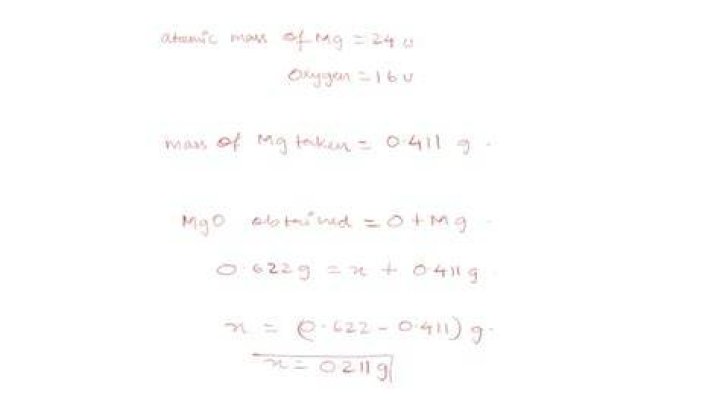
How do you calculate magnesium oxide?
 Madison Flores
.
Consequently, what is the formula for magnesium oxide?
MgO
One may also ask, what is the MG in MgO? The percent composition of magnesium in magnesium oxide with a chemical formula of MgO is 60.30 percent.
Regarding this, what is the purpose of magnesium oxide lab?
PURPOSE: The purpose of this experiment is to determine the empirical formula of a compound. The object of this experiment is to determine the experimental empirical formula of a compound, magnesium oxide, and comparing it to its theoretical empirical formula, MgO.
What are the properties of magnesium oxide?
MgO has the CAS number of 1309-48-2 and its molecular weight is 40.3044 g/mol. Its density is 3.58 g/cm3. Its melting point is 2852 °C (3125 K, 5166 °F) and its boiling point is 3610 °C (3873 K, 6512 °F). It is slightly soluble in water at 0.0086 g/100 ml at 20 °C.
Related Question Answers
What is magnesium oxide made of?
Magnesium oxide (MgO), or magnesia, is a white hygroscopic solid mineral that occurs naturally as periclase and is a source of magnesium (see also oxide). It has an empirical formula of MgO and consists of a lattice of Mg2+ ions and O2− ions held together by ionic bonding.What does magnesium oxide look like?
Magnesium oxide appears as a white solid, often found as a powder. When fine particles of magnesium oxide are dispersed in air, whether directly or when generated by the burning or cutting of magnesium metal, the resulting magnesium oxide fume is an inhalation hazard. A white solid, often found as a powder.Where does magnesium oxide come from?
Magnesium oxide is produced by the calcination of magnesium carbonate or magnesium hydroxide.Why is magnesium oxide a ceramic?
Magnesia (magnesium oxide, MgO) is a specialty ceramic with outstanding high-temperature performance, used primarily in thermal engineering, heating elements, crucibles, and refractory.Why is magnesium oxide a compound?
It is an inorganic compound that occurs in nature as the mineral periclase. In aqueous media combines quickly with water to form magnesium hydroxide. It is used as an antacid and mild laxative and has many nonmedicinal uses. Magnesium oxide appears as a white solid, often found as a powder.Is magnesium oxide acidic or basic?
For example, it would react with dilute hydrochloric acid to produce sodium chloride solution. Magnesium oxide is again a simple basic oxide, because it also contains oxide ions. However, it isn't as strongly basic as sodium oxide because the oxide ions aren't so free.Does magnesium oxide react with water?
In comparison to the two reactions, the barrier of MgO/H2O reaction is lower, and it is concluded that Magnesium Oxide reacts with water first.How many moles of magnesium is 3.01 x10 22 atoms?
Mixed Mole Conversions
| Question | Answer |
|---|---|
| How many moles of magnesium is 3.01 x 10^22 atoms of magnesium? | 0.05 moles |
| How many molecules are there in 4.00 moles of glucose, C6H12O6? | 2.408 x 10^24 |
| Find the mass in grams of 2.00 x 10^23 molecules of C10H15O (called penguinone because its structure looks like a penguin.) | 50.17 g |
What is the ratio of oxygen to magnesium oxide by mass?
3 : 2
What is a mole in chemistry terms?
The mole is the unit of amount in chemistry. A mole of a substance is defined as: The mass of substance containing the same number of fundamental units as there are atoms in exactly 12.000 g of 12C. Fundamental units may be atoms, molecules, or formula units, depending on the substance concerned.How do you find Percent Composition?
Percent Composition- Find the molar mass of all the elements in the compound in grams per mole.
- Find the molecular mass of the entire compound.
- Divide the component's molar mass by the entire molecular mass.
- You will now have a number between 0 and 1. Multiply it by 100% to get percent composition.
How do you find the empirical formula?
Calculation of an Empirical Formula- Step 1: Obtain the mass of each element present in grams. Element % = mass in g = m.
- Step 2: Determine the number of moles of each type of atom present.
- Step 3: Divide the number of moles of each element by the smallest number of moles.
- Step 4: Convert numbers to whole numbers.