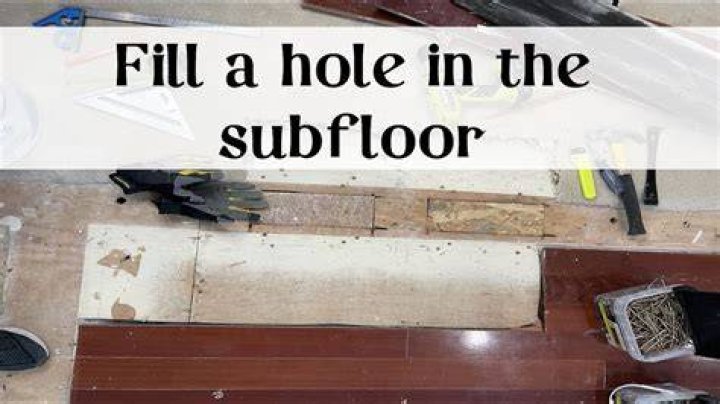
How do I fill the gaps in my subfloor?
 Robert King
.
Keeping this in view, how do you fill gaps in plywood?
Fill voids easily before adhering sheets of plywood together.
- Sand the surface of the plywood with 80-grit sandpaper.
- Combine wood filler with some of the sawdust in a small container.
- Fill a syringe with the wood filler.
- Lift the edge of the one sheet of plywood until you can insert the syringe over the void.
One may also ask, how do you level a subfloor? Mix the floor leveling compound with water in a bucket, following the manufacturer's directions. Pour a generous amount of mixed leveler onto the subfloor, focusing on one or more wavy areas. Spread the leveler over the floor with a trowel or a gauge rake so it covers each low area completely.
Simply so, how do you fill large gaps in wood?
Filling Floorboard Gaps With Wood Putty
- Clean the floorboards on both sides of the gap.
- Apply a fine bead of wood putty to the gap, then work it into the gap with your finger, using circular motions to force the putty down into the gap.
- Remove excess putty from the wood surface using a putty knife.
What is the best wood filler for large gaps?
Two-part epoxy is one of the top choices for patching large holes. Moldings, sills, doorjambs, baseboard or wood trim with damage or large holes can be repaired with epoxy. The two parts are mixed like dough and can be shaped before or after it dries.
Related Question Answers
How do you fill gaps in wood?
Wood putty or wood filler sticks are easy to use and effective for covering over wide cracks in indoor and unstained wood. For a quick fix, a mixture of wood glue and sawdust seamlessly blends in small cracks and gaps in assembled furniture. Purchase epoxy to handle larger gaps, such as on outdoor projects.Can you use caulk to fill wood?
Caulk is most often used to seal joints and cracks. However, if the wooden exterior of your new home is pitted with nail holes, ice damage or other surface gaps, you can use also caulk to fill these holes. Choose a product that matches the color of the wood, or paint the area to match after the caulk has cured.What is the best wood filler?
7 Best Wood Fillers - Reviews- #1. Abatron WoodEpox Epoxy Wood Replacement Compound.
- #2. Donald Durhams Rockhard Water Putty.
- #3. Elmer's E887Q Stainable Wood Filler.
- #4. J-B Weld 8257 KwikWood Wood Repair Epoxy Putty.
- #5. 3M Bondo Home Solutions Wood Filler.
- #6. FamoWood 40022126 Latex Wood Filler.
- #7.
Can I put new subfloor over old subfloor?
One of the benefits of removing the old flooring is it allows you the chance to fix any loose subflooring or squeaks by re-securing the main subfloor to the floor joists prior to installing the new flooring. With all that being said though the answer is YES you can install New Wood Flooring over the old.How thick should my underlayment be?
Underlayment: Just under the visible floor covering is a layer of some kind of material, usually only about 1/4- or 1/2-inch thick. Its purpose is to provide a smooth, flat surface for the floor covering. It can be made of many different materials, chosen depending on the needs of the floor covering.How many layers of vinyl flooring can you layer?
three layers
Should underlayment be glued to subfloor?
No, you should not glue down your underlayment. Underlayment is is a floating material, the same as your laminate flooring. In most cases, you should not glue or nail your underlayment down. You should always check with the installation instructions of the underlayment for proper installation instructions first.How many screws do I need for underlayment?
According to the American Plywood Association installation Guide, they recommend #4 x 1 1/2" ring shank nails as fastners with spacing 6" OC along all edges and 8" OC each way in the field. The underlay is to be installed perpendicular to the subfloor.What do you put down under vinyl floor?
Vinyl floors under 4mm should be installed right over the subfloor. If you have any areas on a concrete subfloor with moisture concerns, it is recommended to use a vapor barrier underlayment that will not add any cushion to the planks.How do you attach underlayment?
- unroll the underlayment. Unroll the Underlayment.
- run underlayment next to longest wall in room. Run the Underlayment.
- covering the floor with underlayment. Cover the Floor.
- cut away excess underlayment. Remove Excess Underlayment.
- cutting boards for installation.
- put in the spacers for transition strip.
- slide planks into place.