Does mepivacaine contain epinephrine? | ContextResponse.com
 Olivia Hensley
.
Herein, does Carbocaine contain epinephrine?
When clinical conditions permit, an effective test dose should contain epinephrine (10 mcg to 15 mcg have been suggested) to serve as a warning of unintended intravascular injection. The test dose should also contain 45 mg to 50 mg of CARBOCAINE (mepivacaine) to detect an unintended intrathecal administration.
Secondly, what dental anesthesia does not have epinephrine? Alternatives to epinephrine-containing anesthesia include Prilocaine and Carbocaine, or even nitrous oxide ("laughing gas"). Plain old Lidocaine is also a decent choice.
In this manner, is Carbocaine and mepivacaine the same?
Carbocaine. Mepivacaine is an anesthetic (numbing medicine) that blocks the nerve impulses that send pain signals to your brain. Mepivacaine is used as a local (in only one area) anesthetic for an epidural or spinal block.
How long does mepivacaine last?
Mepivacaine HCl 2% with Levonordefrin 1:20,000 provides anesthesia of longer duration for more prolonged procedures, 1 hour to 2.5 hours in the upper jaw and 2.5 hours to 5.5 hours in the lower jaw. Mepivacaine does not ordinarily produce irritation or tissue damage.
Related Question Answers
What is the difference between Carbocaine and lidocaine?
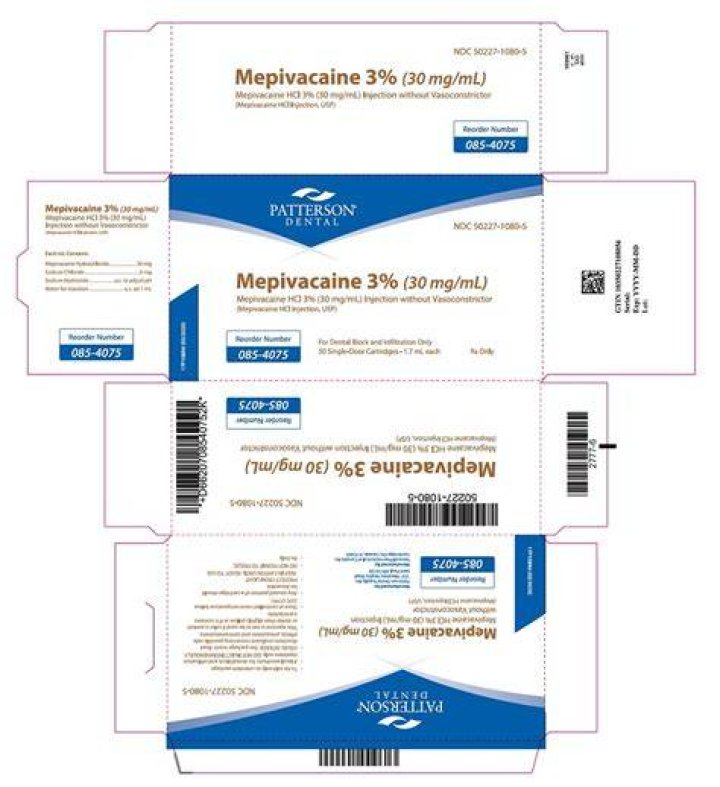
Common Local AnestheticsMepivicaine comes as 3% carbocaine. It too has very rapid onset, and a recommended dosage similar to lidocaine; however, carbocaine does not contain a vasoconstrictor. It is also believed to be less toxic than lidocaine, and it is good for prolonged anesthesia.Is mepivacaine a vasoconstrictor?
Mepivacaine does not ordinarily produce irritation or tissue damage. Levonordefrin is a sympathomimetic amine used as a vasoconstrictor in local anesthetic solutions. In equal concentrations, Levonordefrin is less potent than Epinephrine in raising blood pressure, and as a vasoconstrictor.Is mepivacaine the same as lidocaine?
Mepivacaine (Carbocaine) is the local anesthetic agent most commonly used for regional or intrasynovial analgesia of the foot. Lidocaine is also used for regional anesthesia, but because this local agent is irritating to tissues, the authors do not use it for intrasynovial analgesia of the lower portion of the limb.Is Carbocaine an vasoconstrictor?
CARBOCAINE does not ordinarily produce irritation or tissue damage. Neo-Cobefrin is a sympathomimetic amine used as a vasoconstrictor in local anesthetic solutions. In equal concentrations, Neo-Cobefrin is less potent than Epinephrine in raising blood pressure, and as a vasoconstrictor.What do dentists use instead of lidocaine?
In dentistry, the most commonly used local anesthetic is lidocaine (also called xylocaine or lignocaine), a modern replacement for procaine (also known as novocaine).Why do dentist use epinephrine?
Epinephrine is widely used as an additive in local anesthetics (typically in concentrations of 1:100,000) to improve the depth and duration of the anesthesia, as well as to reduce bleeding in the operative field.Is bupivacaine an ester?
All amide local anesthetics contain an “i” in the name. For example, lidocaine, mepivacaine, prilocaine, bupivacaine, ropivacaine, and levo-bupivacaine all contain an “i” before the “-caine”. Esters such as procaine, chloroprocaine, and tetracaine do not contain an “i” before the “-caine”.What is bupivacaine used for?
Bupivacaine is an anesthetic (numbing medicine) that blocks nerve impulses in your body. Bupivacaine is used as a local (in only one area) anesthetic. Bupivacaine is given as an epidural injection into the spinal column to produce numbness during labor, surgery, or certain medical procedures.How long does Carbocaine take to wear off?
The numbing sensation typically lasts 30 to 60 minutes. Since Novocaine by itself has a very short duration of action, it's often used in conjunction with epinephrine (adrenaline) to make the effects last a little longer. If Novocaine is administered with epinephrine, the effects last roughly 90 minutes.What type of drug is lidocaine?
anesthetics