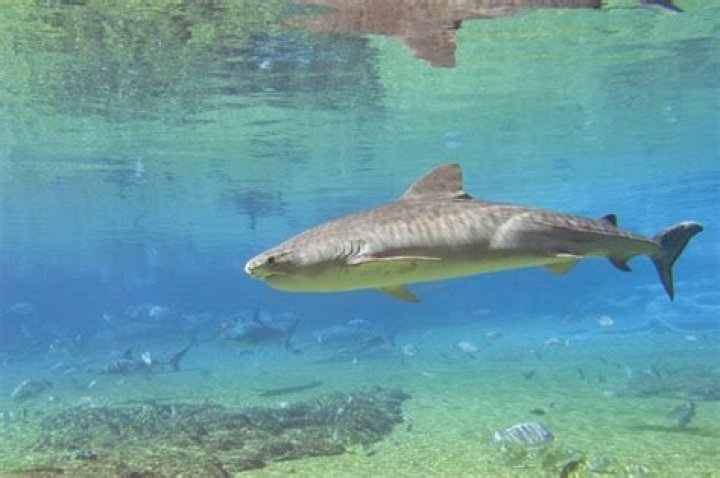
Do sharks sink when they stop swimming?
 Ava Lawson
.
Just so, why do sharks sink if they stop swimming?
Myth #1: Sharks Must Swim Constantly, or They Die However, sharks do have to swim to avoid sinking to the bottom of the water column. This oil is lighter than water, providing the shark with additional buoyancy. The lack of a swim bladder gives sharks some unique advantages.
Likewise, do fish sink if they stop swimming? But they can only rise and dive down through the water by swimming. Modern Fishes have swim-bladders that they can control, so they rise and fall in the water according to the air pumped in or out of the silvery blader, even when they are not swimming.
Subsequently, question is, do sharks die if they stop swimming?
3. If a shark stops moving, it will die. Most sharks don't have to constantly swim to breathe or to stay alive. But about two dozen species—including the great white, the whale shark, and the mako shark—are known as “obligate ram ventilators,” meaning it is mostly essential for them to keep moving to stay alive.
Do sharks sleep while swimming?
While some species of sharks do need to swim constantly, this is not true for all sharks. Some sharks such as the nurse shark have spiracles that force water across their gills allowing for stationary rest. Sharks do not sleep like humans do, but instead have active and restful periods.
Related Question Answers
Can sharks smell period blood?
In a report by Popular Science, period blood actually does not attract sharks. Although sharks can smell blood because of the chemicals (amino acids) it contains, they don't interpret it as their dinner bell. On the contrary, sharks sniff for the scent of their prey of choice.Can Sharks sense fear?
There's the sense of echolocation, found in certain bats and whales. We don't have that, either. Nor the sense related to electroreception, in sharks and other fish. The ability to either sense fear or project fear plays a large part in the predator/prey relationship.How close to shore can a shark come?
Don't think you're safe just because the water is shallow -- shark attacks can occur in less than three feet of water. While shark activity tends to be greater a few hundred yards from shore, stay alert even if you're in thigh-deep water.Do sharks need to swim constantly?
Some sharks must swim constantly in order to keep oxygen-rich water flowing over their gills, but others are able to pass water through their respiratory system by a pumping motion of their pharynx. This allows them to rest on the sea floor and still breathe.What happens when a shark dies?
Upon death, either by sickness or being hunted, any shark or whale eventually sinks to the bottom of the ocean. sharks, rays and skates) as they will sink upon death. Osteichthyes (bony fish, most fish in the ocean) will float as their swim bladders expand upon death so they get eaten by algae and birds.Can a fish drown?
As it turns out, fish can drown in water. “Suffocate” may actually be a better term for what happens to fish, as it isn't technically drowning. Drowning is when the lungs fill with water and are unable to get the oxygen they need.Do sharks have tongues?
Sharks have a tongue referred to as a basihyal. The basihyal is a small, thick piece of cartilage located on the floor of the mouth of sharks and other fishes. It appears to be useless for most sharks with the exception of the cookiecutter shark.Why are sharks dying?
On individual sharksWhen sharks have been finned, they are likely to die from lack of oxygen because they are not able to move to filter the water through their gills, or are eaten by other fish that have found them defenseless at the bottom of the ocean.What sharks don't need to swim to breathe?
"Obligate ram ventilators" are sharks that have lost the ability, and the necessary anatomy, for buccal pumping, and instead can only respire using ram ventilation. Sharks from this group (which includes great white, mako and whale sharks) would indeed die from lack of oxygen if they stopped swimming.Do sharks sleep at night?
While some species of sharks do need to swim constantly, this is not true for all sharks. Some sharks such as the nurse shark have spiracles that force water across their gills allowing for stationary rest. Sharks do not sleep like humans do, but instead have active and restful periods.How do you attack a shark?
If you find yourself in the middle of an attack- Don't panic. So you're being circled by a shark.
- Maintain eye contact. As the shark swims around you, keep your head on a swivel and try to maintain eye contact.
- Stay big or get small.
- Don't play dead. This isn't a bear, it's a shark.
- Cut off the angles.
- Slowly back away.
Can nurse sharks stop swimming?
As an obligate ram ventilator, a whale shark must continuously swim or die. But just how the sharks force water over their gills differs among species. Some sharks, particularly those that are not active swimmers, such as nurse and bullhead sharks, breathe using buccal pumping.How long can a shark live out of water?
But no shark can breathe out of water. This is not a problem for the epaulette shark though, as it can survive 60 times longer without oxygen than humans can! In order to do this the little shark slows its breathing and heart rate and powers down its brain.Do sharks have predators?
Their only natural predators are killer whales and sharks, making them one of the ocean's top predators.How do sharks breath under water?
Like other fish, sharks "breathe" through their gills, which are respiratory organs akin to our lungs. As water passes over the gill's membranes, tiny blood vessels extract oxygen from the water.Can sharks get cancer?
Sharks Do Get Cancer: Tumor Found in Great White. A tumor on the lower jaw of a great white shark, near the Neptune Islands, South Australia. It's the first documented tumor in this species. Scientists have known for more than 150 years that sharks get cancer.Can Sharks get sick?
No, sharks not immune to 'every known disease' The meme claims that sharks “are the only animals to never get sick. They are even immune to every known disease including cancer”.How do you tell if a fish is going to die?
These are some of the most common signs of disease seen in pet fish:- Appearing disoriented, such as swimming upside down.
- Leaving food uneaten.
- White spots on fins or body.
- Discolored gills.
- Trouble breathing such as gasping at surface of water.
- Bulging eyes (one or both)
- Mucus accumulation on the body.